



NT-CP1: Performance characteristics and technical background
Developed and manufactured by Carbice® Corporation, the NT-CP1 is a carbon nanotube thermal pad with unique technical properties and performance characteristics. While thermal pastes and most other thermal pads gradually lose performance over time due to pump-out, delamination, cracking and other degradation effects, Carbice® pads keep improving their performance over hundreds or even thousands of thermal cycles. This makes the NT-CP1 ideal for applications that require superior long-term performance and maintenance-free operation.
The structure of the pad
Carbice® pads utilise a unique sandwich structure that ensures mechanical stability, reliable handling and optimal performance. The centrepiece of the NT-CP1 is a 50µm-thick aluminium backbone that reinforces the 20µm-long carbon nanotube (CNT) forests on the top and bottom sides. Whereas many other carbon or graphite thermal pads are brittle and can easily break when kinked, the aluminium layer, and its proprietary bonding to the CNTs, makes Carbice® pads sturdy and trouble-free to handle.

The aluminium layer also provides a degree of lateral heat spreading, while the vertically aligned CNTs enable excellent through-plane heat transfer. This is a key advantage over graphite films with horizontally aligned structures, which excel primarily in terms of in-plane thermal conductivity, as well as pads with only vertically aligned heat-conducting structures that provide excellent through-plane conductivity but lack comparable lateral heat-spreading capabilities.
Another unique trait of Carbice® pads is that the CNT forests are covered with a nanometre-scale phase-change polymer layer, which helps to keep the vertically aligned CNTs compressible and elastic, allowing them to adjust to variations in pressure and gap size between the contact surfaces. This spring-like behaviour of the CNTs enables the NT-CP1 to bridge varying gap sizes more effectively than non-compressible pads, making it more forgiving in scenarios with less-than-perfect contact quality. At the same time, it makes the pad more robust. Whereas graphite pads expand in other directions when compressed, which can lead to cracking over time, Carbice® pads do not. This eliminates stress in the interface and allows for more surface contact with a thinner material.

In addition to ensuring that the CNTs remain elastic, the nanoscale phase-change polymer coating also makes the contact surfaces of the pad electrically non-conductive (unless penetrated) and slightly tacky, which facilitates installation. Last but not least, it ensures proper surface wetting.
This unique structure also determines the pad’s distinctive performance characteristics.
How it performs – and why
Compared with the carbon nanotubes, the thermal conductivity of the tacky phase-change polymer coating that facilitates installation is relatively low. Before the polymer has liquefied due to heat input from the CPU, the excess polymer tack layer therefore reduces the pad’s overall through-plane thermal conductivity. This is why the initial thermal performance of a freshly installed NT-CP1 pad is clearly lower than that of freshly applied high-end thermal pastes – a built-in trade-off for easier installation. Once the polymer reflows and wets the surfaces of the CPU and cooler, however, the CNT structures couple more effectively to both contact surfaces and the thermal performance of the NT-CP1 improves significantly.

At elevated heat loads of 200W and beyond, this first step of the pad’s activation phase usually manifests itself in a clearly measurable temperature drop within the first 5–10 thermal cycles, during which both sides of the pad are heated above 60°C and then cooled back down below 50°C.
Once the assembly polymer layer has liquefied, the CNT structures couple more effectively to both the cooler and the CPU, resulting in significantly improved heat transfer. At the same time, the CNTs start to straighten and conform to the microcavities of the contact surfaces, reducing thermal interface resistance and further improving overall performance. While the initial polymer reflow occurs within 5–10 thermal cycles, it can take several hundred to several thousand cycles for the CNTs to fully conform to the topologies of the contact surfaces.

This two-phase activation process is why high-end thermal pastes initially perform much better than a freshly installed NT-CP1 pad. The pad starts to close the gap after the first part of the activation phase in which the excess installation polymer reflows, but it can take another few hundred to several thousand thermal cycles for the NT-CP1 to reach its full performance.
This is only one side of the equation, though. While the NT-CP1 continues to improve until it reaches its full thermal performance and then maintains it for many years, conventional thermal pastes suffer from degradation effects such as pump-out, dry-out and cracking. Graphene pads can suffer from cracking as well due to repeated compression in the interface. In other words, the NT-CP1 takes time to reach its full potential, whereas thermal pastes, and alternative pads, perform very well initially but can gradually lose performance over time.

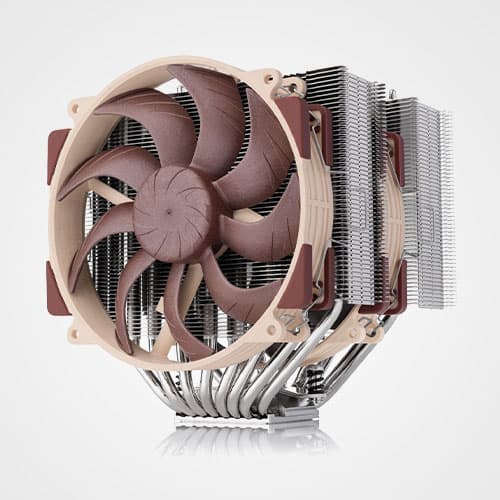
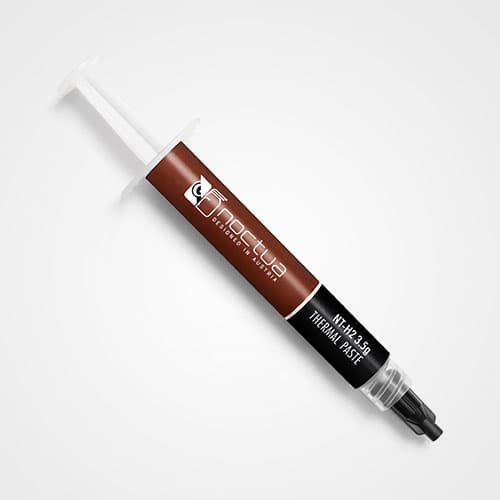
In our long-term tests over thousands of thermal cycles using an NH-D15 G2 LBC cooler on an AMD Ryzen 9 9950X, the NT-CP1 came within 2°C of our NT-H1 after around 900 cycles. After around 1,600 cycles, the gap narrowed to less than 1°C. At around 3,700 cycles, the pad outperformed the paste. From this point onwards, the paste continued to lose performance, whereas the pad remained stable.
In additional testing with an NL-LC1-24 all-in-one liquid cooler on an AMD Ryzen 9 7950X, we observed much faster activation of the pad, with a temperature drop of around 7°C within the first 10 cycles, followed by a further 1.3°C reduction by cycle 500. In this setup, the NT-CP1 began to outperform our NT-H1 thermal paste after only 130 cycles and had already established a clear performance advantage of more than 1°C by around 300 cycles. By 1,000 cycles, this advantage had grown to around 2°C:

In a separate test with a Ryzen 9 9950X running at 200W and cooled by the standard (medium base convexity) version of the NH-D15 G2, the NT-CP1 reached its maximum performance and began to outperform NT-H1 after around 850 thermal cycles:

As these results show, both the number of thermal cycles required for the NT-CP1 to reach full performance and the point at which it begins to outperform conventional thermal pastes can vary significantly between setups. Key factors include contact quality and pressure, temperature gradients across the interface and shear forces between the contact surfaces.
Another factor that can cause variations is how the carbon nanotube forests have grown on a specific pad. Slight local fluctuations in density and tube length can cause individual pads to fit specific contact quality scenarios slightly better or worse, which can affect both the initial thermal performance and the amount of thermal cycling required to reach optimal results.
In a survey that we ran on an AMD Ryzen 9 9950X with our NL-LC1-24 liquid cooler and 12 NT-CP1 samples, we observed a ±1.7K variance on the first runs and a spread of around ±1.3K after 100 cycles:

While these variations due to individual CNT density and length would even out at higher contact pressures, the limitations in terms of pressure specification on today’s desktop CPU sockets don’t allow for a stronger compression that would help to minimise these fluctuations.
In summary, our tests have shown that the number of thermal cycles required for the NT-CP1 to reach its full performance can vary from around 300 to more than 3,000. The rate at which conventional thermal pastes lose performance over time likewise varies significantly between systems, cooling solutions and usage patterns. In combination, these factors make it difficult to predict how the NT-CP1 will perform in comparison to thermal paste on a specific system after a certain amount of time. In our tests, the point where NT-CP1 started to outperform NT-H1 varied from 130 to 3,700 thermal cycles. What’s clear, however, is that thermal pastes are inherently prone to degrade and may need to be replaced eventually, whereas NT-CP1 pads can provide stable performance for the entire lifetime of your system.
Who is it for?
Carbice® pads were first adopted in satellites, data centres and other applications where replacing thermal paste is either impractical or associated with significant costs. In PCs, replacing thermal paste is comparatively straightforward. Nevertheless, most users leave their thermal interface material installed for several years, during which thermal pastes gradually lose performance due to effects such as pump-out, dry-out and cracking.
Enthusiasts often choose one cooler over another for a temperature advantage of only a few degrees. Yet if the thermal paste gradually deteriorates over time, an equivalent amount of performance may be lost without receiving the same attention.
The NT-CP1 is therefore particularly well suited to users who value stable, maintenance-free thermal performance over many years. Its freshly installed temperatures are slightly higher than those of a high-end thermal paste, but performance improves during activation and then remains stable without requiring periodic replacement. This makes the pad ideal for customers who prefer the peace of mind of never having to worry about whether it’s time to renew their thermal paste.
Additionally, the NT-CP1 is particularly suited for users who feel unsure about how to apply thermal paste or who simply prefer its clean, straightforward installation and removal experience over applying and removing paste.
Finally, the NT-CP1 is perfect for customers who want to make a sustainable, eco-friendly choice. Made from recycled aluminium and waste carbon gas in an energy-efficient, low-temperature production process, it has a much lower carbon footprint than graphite-based thermal pads that are produced through energy-intensive mining or high-temperature growth processes. The NT-CP1 pad can also be recycled through standard aluminium Recycling.
How should TIM performance be assessed? Looking beyond day-one results
Historically, TIM (Thermal Interface Material) performance in the PC enthusiast market has been assessed primarily through short-term benchmarks. Most thermal paste comparisons measure temperatures shortly after installation, often over test periods of only a few hours. Such results provide a useful indication of initial performance, but they cannot show how a thermal interface will develop over months or years of use.
In practice, most users leave their thermal interface material installed for several years. The most relevant comparison therefore depends on the intended service life and should consider the complete performance curve: initial temperatures, any run-in or activation period, long-term stability and whether maintenance or replacement may eventually be required.
This does not make either initial performance or long-term stability universally more important. Users who want the lowest possible temperatures immediately after installation may prioritise a conventional thermal paste with excellent day-one performance. Users who value stable, maintenance-free operation over many years may place greater emphasis on long-term behaviour.
The NT-CP1 therefore requires a different way of looking at TIM performance. Rather than judging it from a single temperature measured shortly after installation, its performance is best assessed over the full intended lifetime of the system. It starts behind a high-performance thermal paste, improves progressively as it activates and is designed to maintain its performance once fully conditioned.
Mentioned products
Explore the products featured in this article.

NT-CP1 AM5/4
Related articles
Want to learn more? Explore related articles and resources.
Performance comparison NT-H1 vs. NT-H2
The NT-H2 thermal paste further improves on the award-winning NT-H1. But how much of a difference in performance can you expect to see?
How to speed up the activation phase of the NT-CP1 thermal pad using automated Prime95 runs
The NT-CP1 thermal pad does not require any manual activation. However, it is possible to speed up the activation phase through dedicated thermal cycling...