



As AI-generated imagery becomes increasingly convincing, the question is no longer only what a camera can capture, but also how it can prove where that footage came from. This is the challenge behind CAIM1, short for Counter Artificial Intelligence Machine 1: a portable camera that is being developed to generate cryptographic proof at the moment a photo or video is recorded.
Alongside interchangeable lenses and high-resolution 4K capture, CAIM1 combines onboard hardware attestation with edge cryptographic proof generation. The resulting proof data is passed to immutable, decentralised storage, enabling the origin of the media to be verified independently.

Two intensive workloads in one protective shell
Creating this proof directly in the camera poses a substantial engineering challenge. CAIM1 must capture and process high-bitrate 4K video at 60fps while simultaneously performing the complex cryptographic calculations required to generate verification proofs. Together, these workloads push both the processors and the image sensor to their thermal limits.
At the same time, the components are tightly packed inside a highly protective, mostly enclosed shell that is designed to withstand harsh environments and prolonged UV exposure. Passive heatsinks alone proved insufficient: without active airflow, the processors would thermally throttle and drop frames, preventing the camera from maintaining its intended video performance.
However, simply adding a fan was not enough. As a portable, battery-powered device, CAIM1 requires precise fan control so that cooling is only provided when necessary. Any unwanted fan noise could interfere with onboard audio capture, while micro-vibrations transmitted to the image sensor could cause motion blur or rolling-shutter artefacts. Cooling performance, power consumption, acoustics and running smoothness therefore all had to be considered at once.


Why the NF-A4x10 5V PWM was the right fit
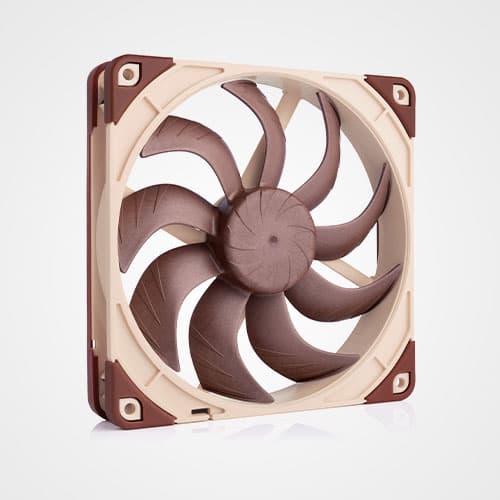
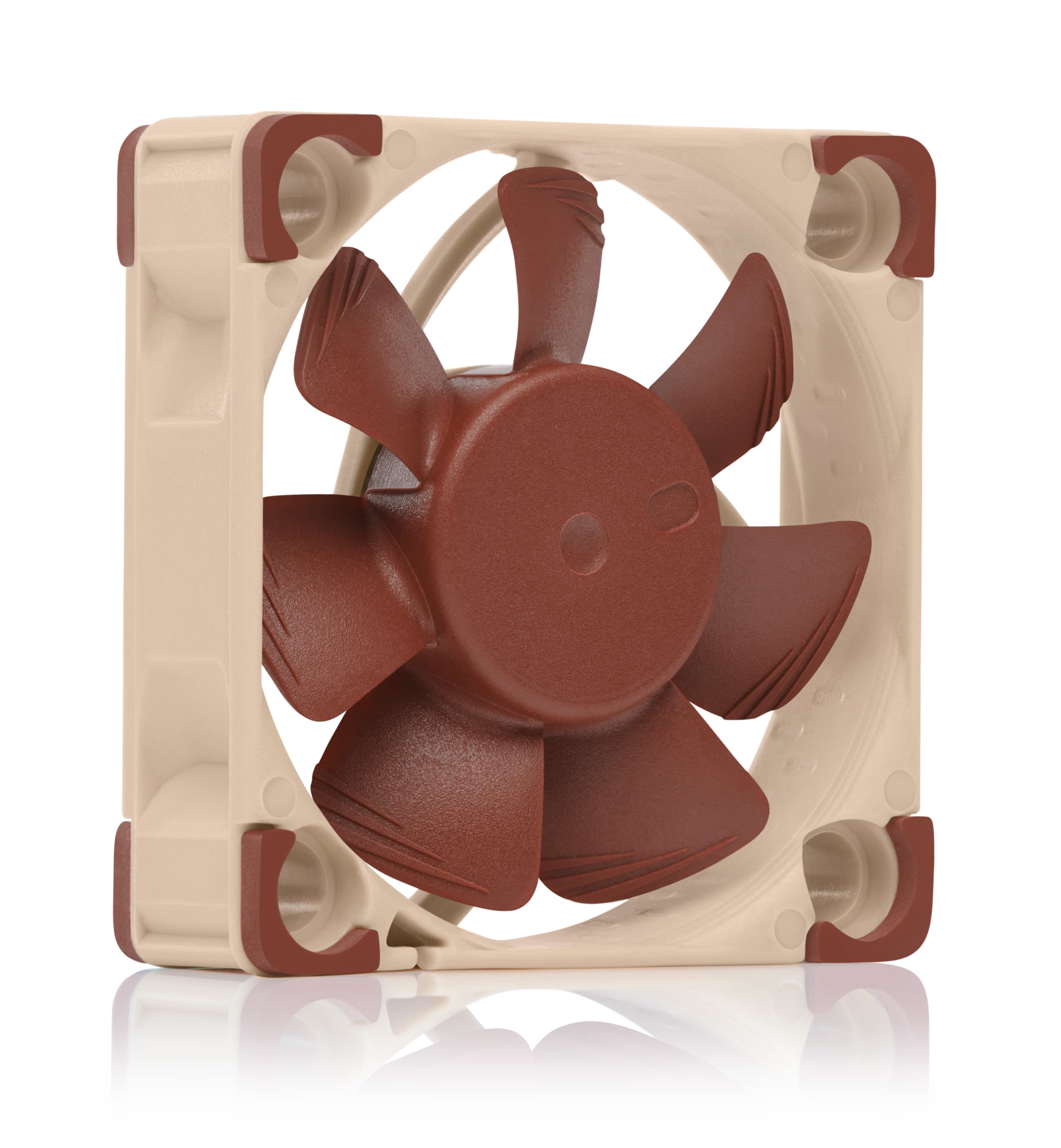
Measuring just 40x40x10mm, the NF-A4x10 5V PWM provides a combination of compact dimensions, strong airflow and pressure performance, low-noise operation and precise PWM speed control. Its native 5V operating voltage was particularly important because CAIM1 runs entirely within a low-voltage battery domain.


Using a conventional 12V fan would have required an additional step-up converter. The CAIM1 team specifically wanted to avoid this, as voltage conversion would consume valuable circuit-board space, reduce battery efficiency and introduce electrical switching noise and ripple that could potentially affect image-sensor performance. The NF-A4x10 5V PWM can instead be powered directly from the camera’s main board, while PWM control allows its speed to be adjusted according to the current thermal load.
Finding the ideal balance between fan size, airflow and noise was so important that the CAIM1 team redesigned the entire main circuit board to accommodate the Noctua fan, relocating major components in order to make room for it. The NF-A4x10 5V PWM’s SSO2 bearing system and smooth motor drive are also particularly well suited to an application in which even minute vibrations and tonal noises must be kept to a minimum.

One fan, one airstream
Rather than using separate fans for the image sensor and the main processor, CAIM1 employs a unified single-airstream cooling design. The NF-A4x10 5V PWM is positioned directly behind the image sensor and decoupled from the main chassis using anti-vibration mounts.

Fresh air is first drawn across the sensor’s alloy heatsink backplate before passing through the fan. The same airstream then moves over the CPU heatsinks and is finally exhausted through the side of the camera. Cooling both major heat sources with a single fan helps to conserve internal space and battery power while reducing the number of potential sources of noise and vibration.
As Josh Cowell, creator of CAIM1, explains:

When designing the CAIM1, our biggest hurdle was balancing the immense thermal output of a high performance edge compute board while keeping it trapped inside a portable, protective shell. We chose Noctua because they provided the absolute best ratio of airflow to physical footprint, enabling us to prolong battery life without thermal throttling. Their fans are so quiet and vibration free that they keep our processors at peak performance without interfering with our audio or image capture at all.
Josh Cowell
Creator of CAIM1
Cooling that is built to last
Reliability was another key consideration. Replacing the fan would require a complex teardown of the camera body, so long-term dependability was just as important as thermal and acoustic performance.
I’ve personally relied on Noctua fans in high-performance systems for almost 20 years, and some units that are more than a decade old are still running flawlessly today. That track record gave us the confidence to choose Noctua for such a deeply integrated component, where long-term reliability is essential.
Josh Cowell
Creator of CAIM1
CAIM1 places an unusually broad set of demands on such a compact fan: efficient cooling within a tightly enclosed space, native 5V operation, precise PWM control, minimal power consumption, low noise, smooth running and long-term dependability. We are excited to see the NF-A4x10 5V PWM become part of a camera that is designed not only to capture important moments, but also to help prove where those recordings came from.

Prototyping with Prusament PETG
The CAIM1 is currently in the prototype stage. To build the latest series of prototypes that will be presented at Ethereum Tokyo week and Pragma Tokyo 2026, Josh Cowell and his team utilised Prusament PETG Noctua Beige and Noctua Brown for the outer shell and fan mount. The current target is to have the first batch available in Q1 2027. However, watch their project closely for opportunities to get hands on with the device earlier.
For more information, visit caimera.one
Mentioned products
Explore the products featured in this article.
NF-A4x10 5V PWM

Prusament PETG Noctua Beige

Prusament PETG Noctua Brown
Related articles
Want to know more on this topic? Explore relevant articles and resources.
The Fractal Design Ridge and the story of “less is more“
05/05/2026
Discover the best Noctua CPU cooler and GPU setup for the Fractal Design Ridge case. See how a custom duct and removing extra case fans unlocks SFF performance.
How we built a ‘Noctua Edition’ Prusa MK4S 3D printer
10/12/2025
We’ve used the new Prusament PLA Noctua Beige and Prusament PLA Noctua Brown to build a custom ‘Noctua Edition’ of the Prusa MK4S 3D printer, one of the workhorses in our labs.