



Are NT-CP1 pads reusable?
Reusing NT-CP1 pads is often possible but not officially supported and not recommended for critical applications. Thanks to their sturdy construction, Carbice® pads are highly robust and, in many cases, the pads can be reused without a significant loss in thermal performance.
However, reusability and performance when reusing cannot be guaranteed as there are several ways in which pads can get compromised. This may lead to reduced performance, so if you see any of the following damage patterns, please do not reuse the pad:
- Strong creases from heatsink removal: If the pad shows creases that might result in a standoff when compressed.
- Delamination and carbon nanotube damage during heatsink removal: If you can see larger areas of bare aluminium where the carbon nanotubes have detached.

By contrast, flow marks and residues of the phase-change polymer coating are normal after use and slight wrinkles (as long as it can be expected that they will flatten out during reinstallation) or isolated spots of exposed aluminium should usually not lead to a significant loss in performance:

While there is a certain risk of damaging the pad when removing and reapplying it, removing and reinstalling your cooler while keeping the pad in place (it may stick either to the CPU or to the cooler) is usually no problem.
Note that damage to the carbon nanotubes is difficult to detect even for trained experts, which is why we generally caution against reusing the pads in critical applications and cannot guarantee optimal performance when reusing.
If you would still like to reuse your pad, we recommend monitoring temperatures after installation to make sure that the pad performs as expected. Keep in mind that a used pad will require more thermal cycling than a new pad for the remaining polymer layer to liquefy and the carbon nanotubes to wick into the micro-cavities of the contact surfaces again, so while you should see performance improving over time, it may take longer than with a fresh pad.
Mentioned products
Explore the products featured in this article.

NT-CP1 AM5/4
Related FAQs
Related articles
Want to learn more? Explore related articles and resources.
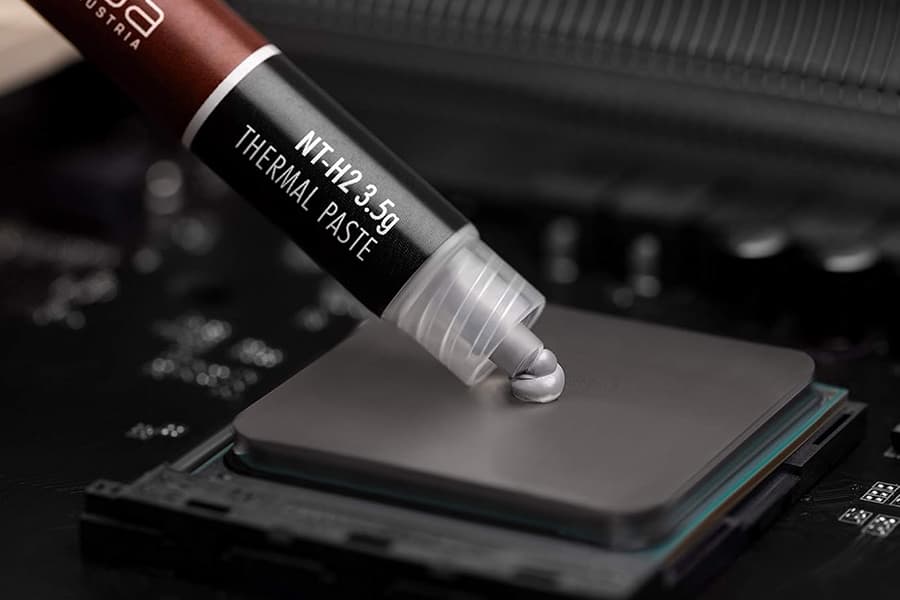
Performance comparison NT-H1 vs. NT-H2
The NT-H2 thermal paste further improves on the award-winning NT-H1. But how much of a difference in performance can you expect to see?
How to speed up the activation phase of the NT-CP1 thermal pad using automated Prime95 runs
The NT-CP1 thermal pad does not require any manual activation. However, it is possible to speed up the activation phase through dedicated thermal cycling...

NT-CP1: Performance characteristics and technical background
The Carbice® NT-CP1 carbon nanotube thermal pad improves over thousands of thermal cycles instead of degrading like pastes, ideal for long-lasting, maintenance-free use.